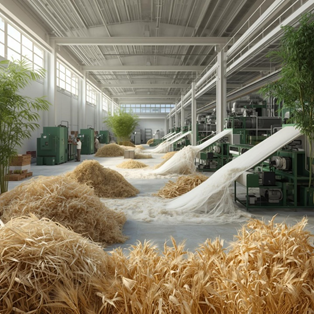
 The core message of the title you provided, “Fiber other than wood: The future of sustainable pulp and paper,” highlights a critical paradigm shift in our industry. While I cannot access the specific link, this direction is strongly supported by recent, credible research, which points towards alternative fibers as essential for a sustainable future.
Recent studies validate this path:
-
Research published in February 2025 demonstrates that herbal waste and maple leaves are viable alternative cellulose sources. Notably, paper made from 100% herbal waste exhibited the highest tensile strength, providing a scientific basis for using agricultural residues-1.
-
Explorations into using birch bark-2 and creating sheet materials by activating natural binders in pine, birch, and redwood bark through heat and pressure-4 further underscore the potential of non-wood fibers, especially those considered “waste.”
💡 Industry Perspective: The Promise of Alternative Fibers
From a practitioner’s viewpoint, the adoption of non-wood fibers is being redefined by technological advancement and sustainability imperatives.
🌾 The Potential
-
Diverse & Sustainable Feedstock: The spectrum of non-wood fibers is vast, encompassing agricultural residues (e.g., straw, bagasse), dedicated non-wood plants (e.g., bamboo, hemp), and increasingly, herbal processing waste, specific leaves-1, and bark-2-4. These sources are often more rapidly renewable than timber and can reduce the industry’s reliance on forests, aiding ecosystem conservation-1.
-
Waste Valorization: Utilizing by-products from agriculture and forestry for papermaking is a form of upcycling. It mitigates environmental pressure from waste disposal and creates new revenue streams, enabling a circular economy-1.
-
Unique Product Properties: Research indicates that papers from certain non-wood fibers can possess unique characteristics. Herbal waste paper demonstrated superior tensile strength-1, while birch bark extracts offer natural moisture and fungal resistance-2. This opens doors for functionally differentiated products.
🔬 Innovation & Technology
Widespread adoption hinges on technological innovation.
-
Advanced Bonding Techniques: Moving beyond chemical adhesives, new research explores intrinsic material properties. Methods include using heat and pressure to activate natural gums and lignin within bark to create binder-free boards-4, or employing plant macrofibers to entangle and bind wood chips for formaldehyde-free particleboard-6.
-
Fiber Extraction & Treatment: Efficiently extracting high-quality cellulose from non-traditional sources is key. Processes like delignification are used to modify and enhance fiber properties for various paper grades-1.
The table below summarizes several promising alternative fiber sources:
| Fiber Source | Key Characteristics | Application Potential |
|---|---|---|
| Herbal Waste & Maple Leaves-1 | Considerable cellulose content (22.4% in herbal waste, 15.2% in maple leaves). Herbal waste paper shows excellent tensile strength. | Packaging paper, specialty papers, eco-friendly paper products |
| Birch Bark-2 | Source of Suberinic Acids (SAs), offering moisture resistance and anti-fungal properties | Specialty packaging, protective building boards, wood treatment solutions |
| Pine/Birch/Redwood Bark-4 | Rich in natural gums, can self-bond under heat and pressure, avoiding harmful glues | Eco-friendly boards, interior panels, furniture substrates |
| Bamboo | Fast-growing, long fibers, good strength | Various tissue & hygiene products, packaging, paperboard |
| Agricultural Straw | Widely available, low cost | Corrugated medium, paperboard, cultural paper |
🚧 Challenges & The Path Forward
Despite the promise, large-scale industrialization faces hurdles, primarily related to cost-competitiveness, establishing stable supply chains, and scaling up production technologies.
A collaborative effort is essential:
-
Boost R&D Investment: Continuously refine fiber extraction and product manufacturing to lower costs.
-
Build Robust Supply Chains: Secure stable, large-scale supply of non-wood raw materials from the source.
-
Enhance Market Education: Help consumers understand and value the environmental and functional benefits of non-wood fiber papers.
-
Advocate Supportive Policies: Encourage governmental support for sustainable paper products through research funding, tax incentives, and green procurement.
🌟 Conclusion
In conclusion, “Fiber other than wood” is more than a technical subject; it represents a central direction for the pulp and paper industry’s transition towards a resource-efficient and eco-friendly future. By actively embracing non-wood fiber resources like agricultural waste, bamboo, and specialty plants-1-2-4, and by driving technological innovation, we can build a more resilient and diversified industry while significantly reducing our environmental footprint.